
Overview
Detachable AI explores psychological theory–based proactive interventions designed to help people disengage from AI chatbots when interactions evolve into emotional over-reliance.
Motivation
AI chatbots are increasingly used for emotional support and companionship. Prior work shows that users can develop emotional dependence over time, and recent studies have begun to measure problematic reliance. However, most research remains descriptive. Few systems proactively intervene when emotional over-reliance emerges, highlighting an opportunity for psychologically grounded design interventions that support healthier disengagement.
To address this gap, we explore three psychologically grounded intervention mechanisms, leading to the following research questions.
Research Questions
How do awareness-focused interventions support users in maintaining awareness of their AI usage patterns?
How does summarizing users’ conversations influence their self-reflection and their perceived relationship with AI?
How can conversational strategies gently encourage users to shift attention toward real-world social connections?
Experimental Design
- Study format: 4-week deployment with weekly check-ins and post-study interview.
- Design: between-subject conditions comparing baseline vs. intervention variants.
- Data: behavioral logs (usage frequency, session duration), weekly survey measures, and qualitative interviews.
Intervention Conditions
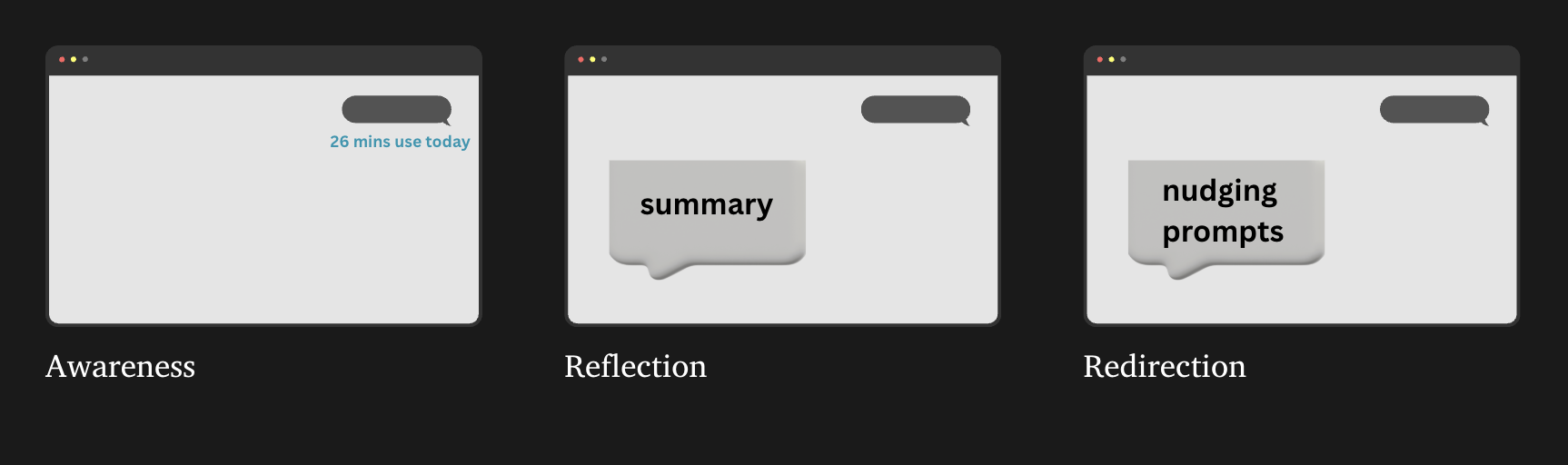
Awareness
- Visualize usage patterns (e.g., time spent) to increase users’ awareness of their interaction behavior.
- Support users in noticing when usage intensifies.
Reflection
- Provide conversation summaries to help users step back from in-the-moment emotions.
- Encourage reflection on recurring emotional themes and reliance patterns.
Redirection
- Use gentle prompts that recall meaningful people or experiences.
- Encourage reconnection with real-world social ties without being judgmental or abrupt.
Planned Analysis
- Quantitative: compare weekly survey changes across conditions (e.g., dependency, self-reflection/insight, perceived relationship quality).
- Behavioral: analyze shifts in usage patterns over time (e.g., sessions, frequency, length).
- Qualitative: thematic analysis of interviews to understand perceived helpfulness, friction, and acceptance of interventions.
Reflection & Lessons Learned
- Structured and synthesized relevant literature into a research framing.
- Articulated theory-driven research questions.
- Prototyped conceptual interventions to support design communication.